
 Image 1 of 1
Who This Class is For
New or Experienced shooters looking to improve their pistol shooting skills
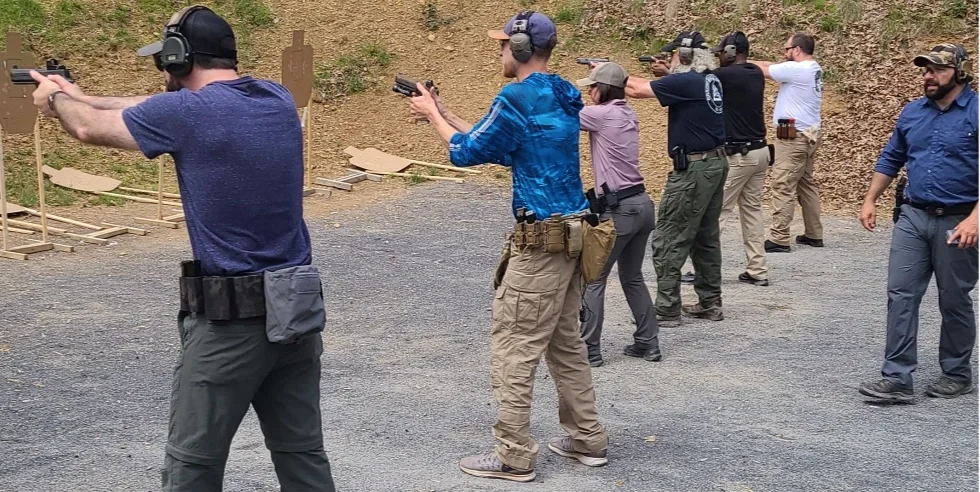
Pistol Shooting fundamentals, safe handling, drawing, reloading, clearing malfunctions and basic pistol shooting drills
Students who have completed the NRA Basic Pistol Shooting Course 1 and 2 (or equivalent) is required.
What You’ll Learn
Firearms Safety
Universal Firearms Safety Rules: International firearm safety rules are based on four core principles:
Treat every firearm as if it were loaded.
Never point a firearm at anything you are not willing to destroy.
Keep your finger off the trigger until your sights are on target and you have decided to fire.
Be sure of your target and be aware of what is around it and beyond it.
General Firearms Safety Rules: The universally accepted safety rules followed by HGP Training Solutions
Range Safety Rules: Common range safety rules that are universally accepted and the specific rules for the range where the course is held
Semi-Automatic Pistol Reloading
Semi-Automatic Pistol Reloads: Include emergency reloads and tactical reloads. These reloads can be practiced using both dry-fire and live-fire drills to build speed, consistency, and muscle memory.
Pistol Emergency Reloads - An emergency reload occurs when a semi-automatic pistol runs out of ammunition and the slide locks to the rear.
Pistol Tactical Reloads - Used when there is still a round in the chamber and ammunition remaining in the magazine, but you want to replace it with a full magazine.
Standard Pistol Malfunctions
Instruction covers common semi-automatic pistol malfunctions, their causes, and the approved HGP Training corrective actions.
Failure to Feed (FTF) - A cartridge fails to load from the magazine into the chamber
Failure to Eject (FTE / Stovepipe) - A spent casing fails to eject and becomes trapped in the ejection port
Double Feed - Two rounds attempt to enter the chamber simultaneously, stopping the slide
Failure to Fire (Misfire) - Trigger is pressed, a “click” is heard, but the round does not fire
Hang Fire - A delayed ignition where the primer ignites but powder burns slowly, causing the firearm to fire after an unpredictable delay
Squib Load - A critical malfunction where a projectile becomes lodged in the barrel. Indicators include a soft “pop,” reduced recoil, and failure of the slide to cycle
Basic Fundamentals of Pistol Shooting
Instruction covers the six core fundamentals of pistol shooting.
1 - Shooting Stance
2 - Master Grip
3 - Sight Alignment and Sight Picture
4 - Trigger Control
5 - Breathing
6 - Follow-Through
Pistol Draws from a Holster
The HGP Pistol Holster Course is a recommended prerequisite for this course. The HGP Level 1 Pistol Course includes an abbreviated review of the fundamentals required for safely drawing from and re-holstering a pistol.
Pistol Holstering Fundamentals
Drawing from a Holster & Re-Holstering: Instruction is based on a simple 10-Step Process designed to establish a proper grip, safely draw from the holster, press the pistol onto the target, fire, reset, and safely re-holster.
Preparation for Basic Drills: Once students demonstrate safe draws with live ammunition, basic shooting drills will be introduced that include drawing from and re-holstering the pistol for each drill. These drills are conducted at 3, 5, and 7 yards and may involve one to three paper targets.
Point-of-Impact (POI) Drills
Point-of-Aim (POA) and Point-of-Impact (POI) drills focus on improving accuracy, consistency, and basic shooting skills such as trigger control and sight alignment. These drills help confirm that your pistol sights or optics are properly zeroed. Students will learn about height over bore, hold-over, and how grip affects shot placement. POI drills are conducted at distances of 3, 5, and 7 yards.
Pistol Zeroing Drill
Blank Target Shooting Drill
DOT Torture Drill
Controlled Pairs (Double Tap) Drill
Progressive Pistol Shooting Drills
Progressive pistol shooting drills are designed to build skills incrementally, starting with basic mechanics and progressing to more complex tasks. The specific drills we cover in this class will be based on how well the class is progressing. We may not get to all of them; but the goal is progression of shooting skills. Safety is the priority so we will only progress to the capabilities of the class.
5×5 Drill (Gila Hayes Version)
VTAC 1-to-5 Shooting Drill
Mozambique Drill (Failure to Stop Drill)
The One-Reload-One Drill (1R1 Drill)
The Bill Drill (Bill Wilson)
Multi-Target “Box Drill” (3 Targets)
Transition Sprints (3-Target)
Prerequisites for this Class
Completion of the NRA Basic Pistol Course (or equivalent)
Completion of the HGP - Pistol Holster Course (recommended)
Completion of the HGP - Red Dot Sight (RDS) Pistol Course (optional)
Waivers: You will be required to read and sign range rules, range waivers, and HGP Training Solutions LLC waivers prior to class.
Please Bring the Following Items to Class
Required Items
Eye and hearing protection
A semi-automatic pistol or revolver
Firearms must be in a proper holster for your pistol
Firearms and holster are available to rent for $25 (must be arranged in advance)
400 rounds of factory ammunition in the correct caliber
No reloaded ammunition allowed
Recommend 9mm Round Nose, 124 grain bullets for rental guns
Recommend round nose or flat nose bullets rated for your pistol
Clothing
Comfortable clothing suitable for the weather
Classes are held rain or shine
Recommended:
Long-sleeve shirt
Pants
Hiking boots or closed-toe shoes (no sandals or open-toe shoes)
Baseball hat
Sunscreen
Knee pads
Food & Water
Packed lunch or snacks
A cooler is recommended (no refrigerator at the range)
Bring enough water or drinks to stay hydrated for 4–8 hours outdoors
No alcohol during classes
Suggested Items
Pencil and notepad
Range belt with holster and two magazine pouches
Three magazines for semi-automatic pistols
Small medical kit
Gun lubricant
Make sure your pistol sights or optics are properly zeroed